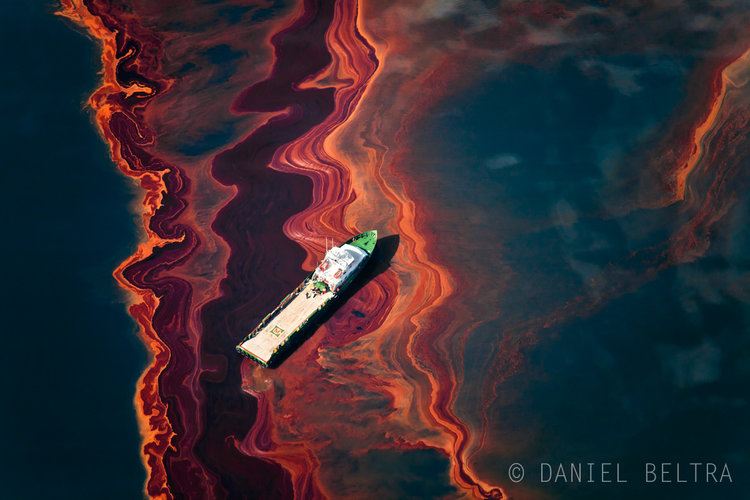


Oil spills are one of the most dangerous threats to bodies of water, both fresh and sea. It implicates continuous discharge of liquid petroleum into the marine ecosystem, resulting in prolonged decay of marine life due to its hazardous nature. However the impact of oil spills are not only environmental but also economical. This article presents the basic macroeconomic consequences of an oil spill with reference to the infamous British Petroleum’s Deepwater horizon oil spill on Alabama in 2010. This article also discusses briefly the positive and negative economic impacts of oil spills. Oil spills majorly affect the commercial fishing, tourism and the real estate of that specific gulf, however the realization of a spill and finding its cause and further correcting the anomaly itself is a very long and laborious process. This causes the spill to have a more adverse effect environmentally and economically.
What Exactly Happened?
On April 20th 2010 the BP Deepwater horizon drilling machinery malfunctioned and exploded leaving 11 workers dead and 17 workers injured.it was estimated that approximately 53,000 barrels worth of crude oil was being leaked into the Mexican gulf every day until the sealing off the leak on 15th July 2010, roughly 3 months after the blast. (NRDC, 2015). As per NRDC’s report on the aftermath of the BP Deepwater horizon disaster, in a span of 87 days approximately 647 million liters of crude oil had surfaced the highly biodiverse Gulf of Mexico and contaminated it beyond repair. Furthermore among the many failed attempts to correct the spill, utilization of 6.9 million liters of toxic chemical dispersants to absorb the surface oil had further contaminated the Gulf of Mexico. This is considered to be the second largest oil spill in history only after the recent realization of the “Taylor oil spill”.
This article typically only deals with macroeconomic data and impacts, microeconomic impacts such as businesses as well as ecological/environmental impacts are largely neglected for clarity purposes.
This oil spill is believed to have polluted 1,100 miles of coastline, 68,000 square miles of surface water and 1,200 square miles of deep sea floors. Furthermore, the government has financed over $1.6 billion to local industries that were adversely affected by the oil spill, however many such claims are still pending. In return the government has only received $1.4 billion by BP as spill related costs, much inferior to the previously agreed amount of $20 billion to be paid to the government by British Petroleum. (Addy.S, 2010).
How Bad was it?
The Blast had resulted in the contamination of 4 US states, Alabama, Louisiana, Mississippi, and Florida. As per Morgan’s paper on “impact of Deepwater horizon blast oil spill on consumer behavior”, the oil spill showed a negative impact on fisheries. This resulted in the complete shutting down of recreational and commercial fishing in areas of Florida and other effected states. (Morgan, 2016).
Furthermore a survey conducted by Bousso in 13 states proved that over 1.8 million planned trips to the affected were scrapped within one year of the explosion. That is approximately $1.3 billion of loss on visitor spending (Bousso, 2018). They also approximated that the oil spill had caused the industrial output to have taken a cut by almost $2.1 billion, $1.37 billion of loss in value added stages and a whopping 21,000 decrease in jobs per year (Bousso, 2018).
Other literature suggests that the oil spill may have caused a complete demographic shift in terms of consumption of sea food. That is a drastic decrease in consumption of oysters, prawns etc. (Court, 2017).
Effect of the Oil Spill on the Economy
A proper analytical study on oil spills is very problematic and complex due to its tangible and intangible effects on environment and economy. Considering that the oil spill occurred offshore and impacted the coastal areas the most obvious and clear impact was on tourism, recreational fishing, commercial fishing and water transport. These further cause indirect negative effects on the economy. Combining these indirect effects along with the direct effects determines the macroeconomic impact of the oil spill that specific region (Addy.S, 2010). Professor Samuel Addy of university of Alabama used the Input –Output Model as other econometric models would have generated a smaller multiplier than that of the input output model. Additionally the input output model considers all the interest on economic interactions in that specific economy. The input-output multipliers were gathered from the Regional Input-Output Modelling System (RIMS II), which is controlled by the U.S. Department of Commerce’s Bureau of Economic Analysis. He then analyzed the oil spills impact on the state economy in terms of sensitivity. I.e. on 4 stages, worst case scenario, likely, most likely and optimistic, with respect to the base year of 2008 due to its stable and complete availability of data.
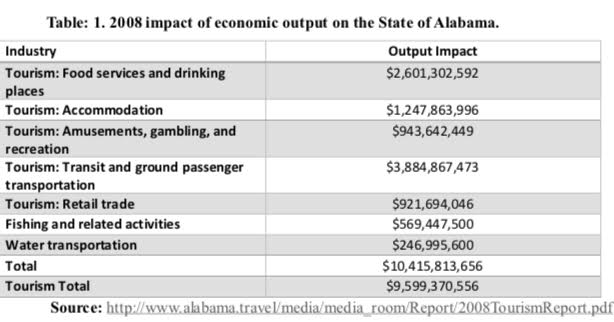
Table 1 here describes the three main affected sectors of the Alabaman economy that is the Tourism sector, the water transportation sector and the fishing sector. However the first 5 components have tourism related revenues and hence the table only describes that portion of the output impact on the Alabama economy. This means that in 2008 the impact of tourism on the state of Alabama was just over $9.5 billion. Therefore if the oil spill was also inland, the complete sector of tourism and its impact of $9.5 billion would have been jeopardy. Nevertheless the oil spill had only taken place in the two coastal counties of Alabama: namely Baldwin and Mobile. These two coastal counties as clear from table 2 account for approximately 33.4 % of tourism Output impact, I.e. $3.2 billion .
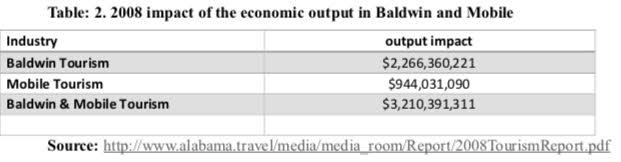
This implies that in the absolute worst case for the coastal area (Baldwin and Mobile), there would have been a decline in economic output by $3.2 billion and 33.4% of the same on the Alabaman economy. Moreover as per Samuel Addy’s work, utilization of the multipliers obtained from the Input-Output model, there had been an approximate impact of $569 million impact on the fishing sector and $247 million on the water transportation sector. However there wasn’t any effect of the oil spill on water transportation as the sea ports were fairly secured from the same (Addy.S 2010).
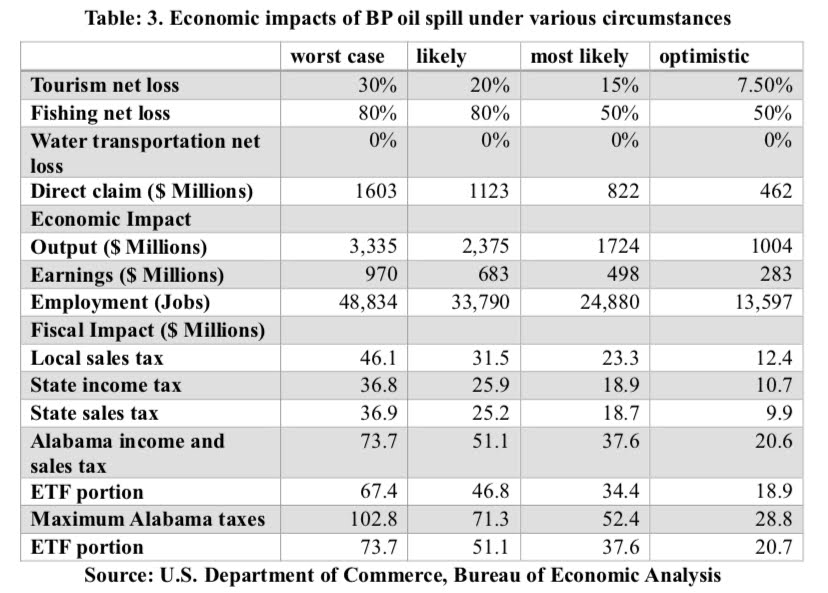
Table 3 shows the various economic impacts in terms of different scenarios. In case of the worst scenario, as per Samuel Addy close to about 49,000 jobs would be lost and earnings would reduce by approximately $970 million. Furthermore the output would decrease by 3.3 billion dollars. In terms of fiscal impacts, in the worst scenario, there is a reduction in sales tax by $46.1 million, $36.8 million in state income tax.
Similarly in case of most likely outcome of the oil spill was estimated to have shown losses in employment by nearly 25000 jobs, loss in earnings by almost $500 million and output to decrease by approximately $1.72 billion. Impact of fiscal measures were estimated to have reduced the state’s income tax by $18 million and local sales tax by $23 million.
Employed and unemployed population in the state of Alabama: 2009 vs 2010
As per JP Morgan Chase’s calculation, the oils spill of 2010 had supposedly boosted the economy in 2012 ever so slightly. (The balance, 2019). Therefore it might have nullified the effect of the oil spill only in the duration of the spill by providing 700 million dollars in form of tourism and fishing, furthermore BP provided 4000 people with jobs whilst spending approximately 6 billion dollars. Nonetheless the long term effects of the oil spill are still not considered and accounted for.
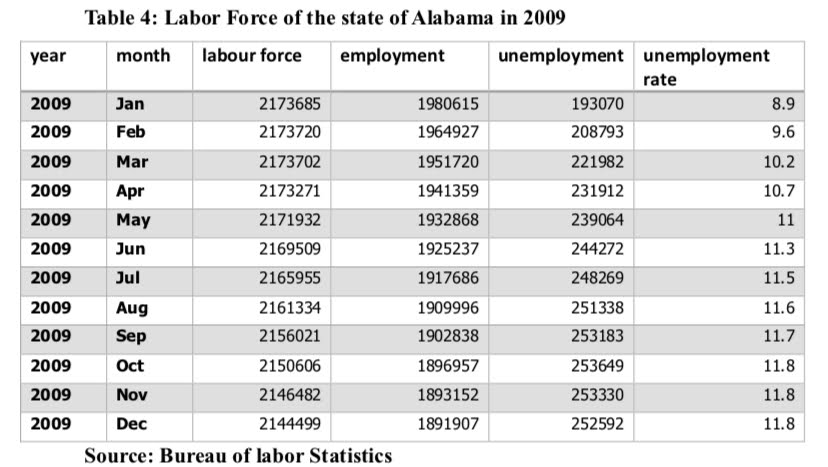
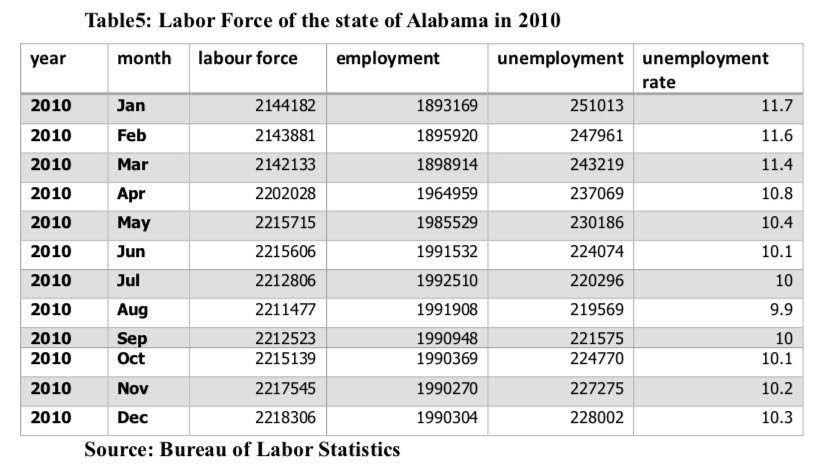
Table 4 depicts the labor force of the state Alabama in 2009. The standard deviation of employment (in thousands) was 27,972 employed people, whereas the standard deviation of unemployed people was 19,172 people. Again in table 5, year 2010’s labor force is depicted. The standard deviation of employed population is 40,311 people, whereas in case of unemployed population is 10,479. It is clear from this that in the year of 2010 employment was more fluctuating however the unemployment was more stable when compared to that of year 2009. Possible explanation for this could be the losing of jobs of fishers who were already employed and the excess decrease in unemployed population due to the clean-up efforts of the oil spill. This is evident from table 4 and table 5, where unemployment is steadily increasing in the state of Alabama in the year of 2009, however the same is decreasing in the year of 2010 when the oil spill had occurred.
Conclusion
Oil spills are possibly the fastest and irreversible way of polluting the marine ecosystem, effects of which are felt both economically and environmentally. While the impact of oil spills on the environment are discussed heavily, this article has only focused on the macroeconomic impacts of the same at the state level.
It is clear from the analysis of secondary data that oil spills have both negative (short term) and positive (long term) impacts on certain macroeconomic variables. They have a negative impact on employment (in short term), tourism and commercial fishing industries of the state affected. They also have a positive impact on employment (in long run) mainly in form of correcting the anomaly.
As per Moody Analytics’, the environmental effects of the oil spill are complex to calculate and effect of the same on the national GDP would be minimal, further proving our analysis that the decrease in unemployment in the consequent years after the oil spill result in a nullifying effect (economically only).
References and further readings
Adams, A. (2015, june). Summary of Information concerning the. NRDC issue paper, pp. 1-3.
Addy, S. (2010). Some Preliminary Macroeconomic Impacts. Center for Business and Economic Research.
Bousso, R. (2018). BP Deepwater Horizon costs balloon to $65 billion.
URL: https://www.reuters.com/article/us-bp-deepwaterhorizon/bpdeepwater-horizon-costs-balloon-to-65-billion-idUSKBN1F50NL retrieved on 1st July 2019
Chris Court, A. H. (2017). Economic impacts of cancelled recreational trips to Northwest Florida after the Deepwater Horizon oil spill. Florida Legislature’s Office of Economic and Demographic Research.
Morgan, A. (2016). easuring the Impact of the BP Deepwater Horizon Oil Spill on Consumer Behavior. Boone: Appalachian State University.
Amadeo, K (2019). BP oil spill Economic Impact: The Balance.
URL: https://www.thebalance.com/bp-gulf-oil-spill-facts-economic-impact-3306212 Retrieved on 2nd July 2019.
Bureau of Labor Statistics, United States Department Of Labor
URL: https://www.bls.gov/home.htm
Retrieved on 4th July 2019
 Harshit's Blog
very interesting and informative.
LikeLike
Brilliantly explained and thoroughly researched
LikeLike
Very well written and explained! We need to work on our environmental laws
LikeLike
Brilliant research and well written
LikeLike
Very nice work
LikeLike
Very informative and well structured! Great work!!
LikeLike
Very well written!
LikeLike
The structure of the article was perfect as it answered all the questions the reader would have one after the other. It had alot of statistics which helped us understand the seriousness of the situation. Good work!
LikeLike
It was well structured and the statistics helped proved the seriousness of the oil spills as well as how the macro economic factors are affected by it.
Great work!
LikeLike
Great blog. Really informative.
LikeLike
Unique topic + good analysis = infotainment? All I’m trying to say is that it was a fun read 🙂
LikeLike
Very well researched. Great work
LikeLike
Very well written!
LikeLike